I just ran across this newsflash and wanted to share. It is very concerning, especially to farmers such as myself who are trying our best to protect the food suply and the ground used to produce it for the next generation. I have not personally doublechecked the validity of this article, but I do trust the source from which I discovered it, and unfortunately it is totally believable.
The Organic Elite Surrenders to Monsanto: What Now?
Whats the one paragraph summary of this? Well, it says that hte largest supporters of "organic foods" ... the people that gave us mainstream organics... have given up fighting agasint genetically altered foods being included into organic food. They have also given up in pushing for you and I to have a right to know when food contains genetically altered components. They have settled for being paid hush money to go away, stop fighting "progress" and accept hte inevitable. This means that in the near future genetically modified foods will be included into organic foods. Further in the future the presence of non genetically altered crops will disappear just as has almost happened in soybeans already. You and I will hav no option but to purchase and consume genetically alttered foods in the long run. Our children or grandchildren may never know what non genetically altered foods are.
Why does Monsanto want genetically altered food? Simply, more profit for them. Monsanto is altering our common food sources genetically so that the foundational foods inside can withstand Monsanto's herbicide Roundup. This allows factory operations to use roundup in increasing quantities without disturbing the plants becasue te plants are altered to be immune to the herbicide's effects. No testing, nor consideraton is given to the consequences for the soil, the bugs, or the consumers of the food of using more Roundup. Monsanto just wants to clear hte way legally to do the previously unthinkable, and not even have to inform the public.
Some people think organic modification is about "feeding the world", well it isnt. It is about more profits for hte companies like Monsanto producing chemicals and attempting to make hte world dependent on thier chemicals. These chemicals never existed until the last hundred years, and were never necessary. It ks the use of chemicals that makes hte use of chemicals necessary. We dont need chemicals to feed the world, in fact, the reliance on chemicals is what makes feeding hte world so difficult and so reliant on oil.
So once again.... profits takes precedence over common sense and morals. Those that defined organic food to most of america have given up so that a few can make more profit. The sad thing is.. we will not pay the price for this, our children and grandchildren will, and those that made the profit will be long gone.
If there ever was a time to find a local organic, humane, natural, heritage farm near you, today is the day. Find one, support them by buying their products, and stand by the ones tha produce food for you and yoru family. These folks (like us) are quickly becoming the last man standing in this battle to preserve foods and nature.

Follow along our adventure as we make the transition from corporate city life to the world of natural farming. Each day brings a new experience and brings us to a deeper understanding about the life and spirit that made America great. At our farm we do our best to give the animals we raise a natural, free, happy, stressfree lifestyle. Our mission is to learn and share how to manage a farming operation that is both profitable and humane.
Sunday, January 30, 2011

January is a popular month for little sprouts blog
January ends with the best month yet for the Little Sprouts Farm Blog. The blog site recorded over 2500 hits for the month! What a great testament to the interest in natural healthy food production. There is a steadily growing interest in our food supply, people questioning what goes on behind the scenes and what are we eating. It goes beyond curiosity. The people that contact us are generally very committed to changing thier family's lives by rejecting the factory food production methods and turning to local natural alternatives whenever possible.
A good point to make is that the vast majority of the people visiting our website are within 100 miles of Medford, OR.

I will add that so far, facebook advertising has been the most effective form of advertising we have done to attract local people. That in itself is amazing to me since we tend to think of the interent as a global resource.
A good point to make is that the vast majority of the people visiting our website are within 100 miles of Medford, OR.
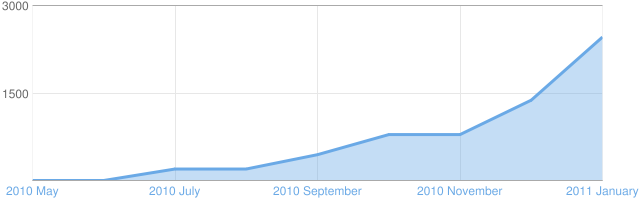
I will add that so far, facebook advertising has been the most effective form of advertising we have done to attract local people. That in itself is amazing to me since we tend to think of the interent as a global resource.
How can you tell if chicken eggs are truly healthy and flavorful?
Over the last 3 years we have learned a lot about chicken eggs. The most amazing fact we have learned so far is the simple fact that eggs are not all the same. In fact, there is a vast difference in eggs depending on breed, lifestyle, and food source. Unfortunately the eggs sold in the grocery store rarely live up to the labels on the packaging. The terms used today are confusing, and few people realize how misleading the term is to how the chickens live.
First, you might want to browse or search this blog for a prior posting on the nutrition of eggs. The truth is that eggs change severly in nutritional value based on how the chicken is treated and fed,. Look for the blog post on this for a deeper discussion on this fact.
So the question is, since we now know that eggs change in nutritional value so easily, how do you know if the eggs you are buying are hte best? Well the obvious and acurate way is a lab test. But this isnt practical as a way to rate eggs for yourself. So.... here's some tips. The best egg can be described as:
Yolk Color - The yolk should be bright orange. Yellow yolks are lacking. In fact the more oragne the yolk is over yellow, the more nutritious it is.
Yolk density - The yolk should be thick, almost like a custard. Thin watery yolks are lacking. When you slow fry a good healthy egg, the yolk stays as a tight round ball while the whites cook. In fact the yolk should be difficult to break open, and when it does it should be thick.
White density - The white of hte egg should have two distinct parts to it. If you crack a good egg open on a plate you will see the yolk in the middle surrounded by a thick white that stands up around hte yolk, and that surrounded by the thinner egg white that spreads thin. If there is not two distinct layers to the whites this way, the egg is lacking.
Shell membrane - the soft membrane on the inside of the shell should be thick and sturdy. When you crack the egg the membrane should be slightly difficult to pull apart. The membrane should hold the egg shell pieces together tightly after cracking agasint a flat surface. If the membrane seems to be nonexistant or is thin, the egg is lacking.
Shell hardness and thickness - The egg shell itself should be sturdy and thick. Cracking the egg should require some force. Shells that are thin and crack easily are lacking.
Apparently a common test by picky chefs for good eggs is the ability to play ball with the yolk. If you can toss the yolk around in a bowl without it breaking open, the egg is good. (this wording corrected thanks to comment below)
Another sign of good eggs is a variety of sizes, shapes, and colors (hues). In nature eggs of the same breed of chicken do not come out identical every time. There should be slight variations in each. If the eggs are totally consistent in shape, size, and color ou can be pretty sure that the chickens are the factory raised genetically bred chickens. Factory style practices strive to produce identical eggs for internal reasons. Nature produces variety.
So, go check your eggs. If they dont look like what is described above, I challenge you to try fome real farm fresh eggs that are truly pacture raised without a steady stream of commercial soy and corn chicken feed. You will be amazed at the diffrence! And remember, if your egg yolks are yellow, be careful to follow dietary guidelines about not eating too many, they are dangerous to heatlh.
Saturday, January 29, 2011
Three Hogs Butchered Today - time to review the business side
The last three hogs from the very first litter here on the famr were butchered today. The hogs were right at seven months old. So far the timing of everything in our hog business is working out nicely.
The hogs will weight in at about 210 to 220 hanging weight, and have about an inch to inch and a quarter of back fat. All good numbers for this breed.
Here are some interedting numbers concerning the business side of hog farming. I like to split their lifespan of 6 to 7 months in half to calculate feed costs. Over hte fist three months the pigs consume on average about 3 lbs of feed per day. This counts a month or two of nursing. for hte last 3 to 4 months they consume about 7 lbs of feed per day. That makes a total feed consumed per hog throughout a 7 month lifespan to be :
270 lbs + 840 lbs = 1110 lbs of feed which produces a hog of about 225 lbs.
This represents about a 4:1 feed conversion ratio over the lifespan.
Thus you can see why we need to keep the cost down through use of organic produce through cllecting, donations, and growing, plus the sprouting of whole grains which are cheaper than commercial organic feed.
There is two balancing concerns in the world of farming - quality and cost. At the end of hte day, the farmer has to make a profit or he can not continue to produce. Likewise, the quality of hte product produce has to be maintained to a level that people are happy to pay the price asked. This is a carefuly balancing act that must be viewed and reviewed from both the consunmer and business side. In addition to this is the scale factor that asks, ho much product can be produced to incease profit without compromising quality. (in Farming, unlike factories, quality is in direct relation to scale, the higher the quantity, the more difficult it is to maintian quality).
For now, we are happy with our pricing model, our cost, and the quality we are able to produce. This primarily due to the fact that we do not depend on any single veture to produce the profit for the farm. If we did, the scale for htat venture would reduce quality to a point where it is not sustainable. Instead, we are branching out into a wide variety of products, species, and offerings. That, in my opinion, is one of the secret formulas for sucess in farming today, the one that matches the traditional family farm of a century ago.
Time to outsmart the Hogs!
Today is the day... At least two hogs are scheduled to be butchered today. The "fun" part is always getting them into the processing pen to await their fate. This morning I am up bright and early, before the sun, to close the shelter pen gates and coax out the two that I want without letting the others get in the way.
It would certainly be a lot easier to do this the modern way of keeping the hogs in separate small pens and thereby having full control over them. But that would violate the basic principles of Little Sprouts Farm! We strive to provide as natural of a life as possible for each animal, which means we do not cage them like criminals in a tiny cell to live out their lives. Our principles dictate that we allow them free roam of enough land for them to feel free and able to live to their instincts.
So.. here I go to try to outsmart them. The amazing thing about these hogs (I am not sure if all are the same as the heritage breeds) is their capacity to learn. If these guys do something one time, only one, they learn it. I have often tried to simply herd them in a certain point and if I fail only once in my objective, the game is over in that way. You simply cant repeat a failed attempt, they have already learned what you are up to and how to work around it if they disagree. So herding these guys is truly a matter of matching wits. I have to change the approach enough so that they never know what to expect. I also have to be careful not to let others watch what is going on with one, because they learn that way also. If they see one hog treated a certain way and object, any that watch will refuse to go down the same path. It truly is an amazing testament to their intelligence.
Its even to the point that if I allow any adult hogs to watch me close and lock a gate, they will proceed to test that lock and gate to see if they can open it. Its not a matter of do they know how, its only a matter of can they physically do it. They know how by watching me!
So here I go! Hopefully in a short time there will be two safely locked away in the barn pen.
Subscribe to:
Posts (Atom)