

Follow along our adventure as we make the transition from corporate city life to the world of natural farming. Each day brings a new experience and brings us to a deeper understanding about the life and spirit that made America great. At our farm we do our best to give the animals we raise a natural, free, happy, stressfree lifestyle. Our mission is to learn and share how to manage a farming operation that is both profitable and humane.
Showing posts with label ebooks. Show all posts
Showing posts with label ebooks. Show all posts
Sunday, February 12, 2017

Sunday, February 5, 2017
Progress on the Book Series - "Save the Children"
It has been a very long weekend!
With only two weeks left before the big Grand Unveiling in Texas at the Mother Earth News Fair, we are scrambling to finish enough book material to meet demand. The goal is to have some books available for sale, and some as "mock-ups" to show the content and depth across the entire series. This will enable "pre-sales" of the series (at a discount of course).
But it is a sizable amount of work to prepare eight books, complete with covers and chapters on short time frame. Fortunately, it looks like we might just make the deadline for ordering books from the print on demand service.


Here is a sneak preview of the entire line of books coming :
Save The Children: Restoring Health Through Grandpa’s Farm
Book 1. Grow Your Own Feed: The Model
Stop outsourcing animal feed
Book 2. Grow Your Own Feed: Drip Irrigation System Plans
Automate germination to harvest
Book 3. Grow Your Own Feed: Gardening for Animal Nutrition
Create Live Feed from Sun and Soil
Book 4. Grow Your Own Feed: Fertilization and Land Rotation
Let the Animals do the Work!
Book 5. Grow Your Own Feed: Fertigation
Irrigate with Fertilized Water
Book 6. Grow Your Own Feed: Weed Burning HowTo
No Chemicals – Low Labor – No Weeds!
Book 7. Grow Your Own Feed: Pest Control with Guinea Fowl
Turn Garden Pests into a positive
Book 8. Grow Your Own Feed: Dehydrating the Harvest
Storing Home Grown Feed
The theme of this series is "growing feed on farm" to raise quality, save money, and create profits for the farm. This is one of the cornerstones of our model. Growing high quality produce based feed on farm is the key to raising meat products at low cost without sacrificing quality. The animals are healthier consuming fresh or dehydrated produce, grown in soils fertilized by a variety of species living out in the sun and fresh air. There is just no way to duplicate this in a bag of dried feed bought from a supplier.
Following this series will be additional series on other aspects of small profitable farming and creating nutrition. The key is the synergy created buy combining all the right ingredients.
But for now... It's time for a good nights sleep.
With only two weeks left before the big Grand Unveiling in Texas at the Mother Earth News Fair, we are scrambling to finish enough book material to meet demand. The goal is to have some books available for sale, and some as "mock-ups" to show the content and depth across the entire series. This will enable "pre-sales" of the series (at a discount of course).
But it is a sizable amount of work to prepare eight books, complete with covers and chapters on short time frame. Fortunately, it looks like we might just make the deadline for ordering books from the print on demand service.


Here is a sneak preview of the entire line of books coming :
Save The Children: Restoring Health Through Grandpa’s Farm
Book 1. Grow Your Own Feed: The Model
Stop outsourcing animal feed
Book 2. Grow Your Own Feed: Drip Irrigation System Plans
Automate germination to harvest
Book 3. Grow Your Own Feed: Gardening for Animal Nutrition
Create Live Feed from Sun and Soil
Book 4. Grow Your Own Feed: Fertilization and Land Rotation
Let the Animals do the Work!
Book 5. Grow Your Own Feed: Fertigation
Irrigate with Fertilized Water
Book 6. Grow Your Own Feed: Weed Burning HowTo
No Chemicals – Low Labor – No Weeds!
Book 7. Grow Your Own Feed: Pest Control with Guinea Fowl
Turn Garden Pests into a positive
Book 8. Grow Your Own Feed: Dehydrating the Harvest
Storing Home Grown Feed
The theme of this series is "growing feed on farm" to raise quality, save money, and create profits for the farm. This is one of the cornerstones of our model. Growing high quality produce based feed on farm is the key to raising meat products at low cost without sacrificing quality. The animals are healthier consuming fresh or dehydrated produce, grown in soils fertilized by a variety of species living out in the sun and fresh air. There is just no way to duplicate this in a bag of dried feed bought from a supplier.
Following this series will be additional series on other aspects of small profitable farming and creating nutrition. The key is the synergy created buy combining all the right ingredients.
But for now... It's time for a good nights sleep.
Saturday, December 24, 2016
First book in paperback on Amazon
Just in time for Christmas, our first book is now available in paperback on the amazon website. It's definitely exciting to see the book on amazon.. Actually surreal is a better term.
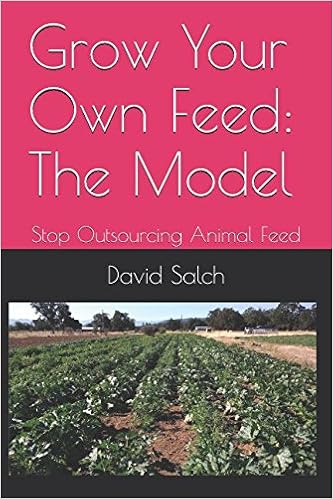
You can order it here: https://www.amazon.com/dp/1520227116
This is being fulfilled through "print on demand" service, which is great for a new author! They actually print the books, one at a time as they are ordered. that way there is not the huge investment up from in making the first shipment of books on speculation.
It is also available now in Amazon as a kindle download through this link:https://www.amazon.com/dp/B01NGZ5LUX
Hopefully this is the beginning of a new trend in small farms making healthy foods across america!
Merry Christmas!
You can order it here: https://www.amazon.com/dp/1520227116
This is being fulfilled through "print on demand" service, which is great for a new author! They actually print the books, one at a time as they are ordered. that way there is not the huge investment up from in making the first shipment of books on speculation.
It is also available now in Amazon as a kindle download through this link:https://www.amazon.com/dp/B01NGZ5LUX
Hopefully this is the beginning of a new trend in small farms making healthy foods across america!
Merry Christmas!
Thursday, December 22, 2016
Converting ODT to EPUB or MOBI using Calibre
This post will likely seem off topic for the typical readers of our blog. It is concerning the process of publishing eBooks. Now that we are deep into the throws of the publishing world, these details are a big part of daily life!
Background: The books I am writing are being written in Libre Office on Ubuntu, saved as .ODT files. The conversion to PDF is simple, as Libre office has a "export to pdf" function that works amazingly well and all features of Libre seem supported in the resulting near perfect PDF file. PDF is fine for self publishing and distributing off a website such as this, but none of the major eBook retailers support PDF.
The reason is simple... PDF is a really cool and flexible set design format. It allows creativity to place objects and text around the page as in written works. EBook reader, however, do not accept PDF. They prefer a format that allows restructuring on the fly to fit a variety of screen sizes and shapes and resolutions. this presents a problem for PDF becasue the exact thing that PDF is best for, fixed structure, is something not allows in the ebook reader world. These readers work more like a web browser, dynamically flowing text to match as things are scaled up and down on various platforms.
So, The next step in our process was converting to EPUB and MOBI (for Barns &Noble and Kindle respectfully). WOW, what an experience this was! I chose to use the converter software called Calibre becasue has the highest recommendations and most control. Calibre will acept many formats and spit out many other formats, mostly right. What it cant do is deal with a fixed structure format in a flowable world. This caused many hours of searching the help pages, the internet, and finally trial and error. There just isn't much information available because of the vast number of possibilities of input format to output format.
I wanted to document what I learned specifically about converting ODT to EPUB using Calibre on Ubuntu. (I dont thin the OS matters at all, but worth mentioning). Here is the list of issues to deal with that are not well documented:
A. Graphics and captions
Libre Writer allows frames to hold the captions of graphics in a nicely formattable way. NOT COMPATIBLE WITH CALIBRE! The frames themselves do not get interpreted properly and mess up the page. The only option seems to be:
- remove captions and paste graphics only (anchored to paragraph text)
- Place the cations into the graphics themselves
B. Table of Contents
Libre Writer does a fabulous job of building and maintaining a table of contents automagically. Unfortunately this is wholly incompatible with Calibre. Instead, use the Calibre "create table of contents" feature based on headers in the document, and remove the embedded table of content entirely. This is ok, as it actually makes no sense to leave it. EBOOKS have no page numbers, because the pages are fluid as the text flows to fit. The Calibre created TOC is not based on page numbers, but clicks to go there. That works well. Unfortunately this does mean keeping two copies of a finished doc, one with TOC for PDF, and one without TOC for EPUB
C. Track Changes
Calibre has this interesting quirk, anything it doesn't understand is just thrown into the front of the ebook, sort of like its saying "I don't know about his part, so look here first. Changes pending under the Libre "track changes" feature are one of those that it doesn't understand. Be sure to accept or reject all changes within the document before conversion to EPUB.
D. Page Breaks
Calibre will add page breaks where it or you wants to. This si controllable in the conversion settings. You can choose which level of headings create breaks, H1, H2, N3, etc. The default is to break after both H1 and H2. This is easily adjustable if its not what you want.
E. Embedded fonts
If you care about the final look and formatting, embed the fonts used. Dont depend on the font being available on the reader device. Substitute fonts are never perfectly alike and causes weird changes. This is easily settable in the conversion setting of Calibre
F. Tables
this is perhaps the most difficult one! Tables are a way of force formatting text on a page. Again, totally incompatible with the goal of eBook readers. There are options on this:
- Do not use tables, organize in some text only fashion that makes sense
- Use tables and let Calibre "flatten them", which pretty makes the table unreadable
- Use Tables and let Calibre leave them tables, which makes them mostly unreadable since they fall off the edge of the reader screen into oblivion
- Build the table in a graphic program, save as an image, and paste it into the document
Number four is the only one that truly works and preserves the layout of the table. It is a pain though since it means more objects to manage to build a book when changes are necessary.
E. Cover
Several options on what to do with a cover. Calibre can expect an outside file as the cover, but if you do that and also produce PDF, you must maintain two copies again (one with and one without cover embedded). What I ended up doing is making a full page graphic for the cover, text and all, and putting that on the first page of the document. then do not tell Calibre to use a graphic nor to use the first page. Just leave all cover settings alone. That produces a PDF and EPUB that look identical with no intervening steps.
One thing I did do is to set Calibre to scale the cover proportionally... that preserves the look of the cover as it stretches onto different device screens.
F. Properties
Calibre is supposed to pick up "customer document properties" from Libre Writer, but I have not been able to get this to work. What that means (if I cant solve it) is that each time a new file is converted, you have to enter the properties like author, publisher, etc manually. You do what these to allow for better searching within the ebook retailer.
That's about it for now... Nearly at a usable EPUB file !
Sunday, December 11, 2016
First eBook Released! - Join the Revolution!
The small family farm is one of the key aspects that built America. Once upon a time, small family farms covered the landscape from seas to sea, producing good local food for the masses. Today, not so much. Today the small farm is hard to find, and when you do, it is supported by off-farm income!
The reason? many actually... But the bottom line is, the conventional model does not work! With the conventional model, even organic, much of the profits of farming is passed along to other industries. Sustainability is an elusive thing with so much dependence on "imports" from outside of feed, fertilizer, labor, etc.
The answer? We have been working on this for years now. Producing a small farm model that can show a profit while producing healthy local food.
Now (drum roll please) we are sharing our model with others, with you. We are producing a series of downloadable books explaining every aspect of our model, in enough detail for you to implement a system that WORKS on your farm.
the first eBook is available for download now! It is not entirely "polished" but we didn't want, this information is just too important. So we are releasing it now, in its slightly unfinished form, and offering free updates as it is matured.

More books will follow as quickly as possible. For now, please consider buying a copy for yourself.
http://littlesproutsfarm.blogspot.com/p/books.html
The reason? many actually... But the bottom line is, the conventional model does not work! With the conventional model, even organic, much of the profits of farming is passed along to other industries. Sustainability is an elusive thing with so much dependence on "imports" from outside of feed, fertilizer, labor, etc.
The answer? We have been working on this for years now. Producing a small farm model that can show a profit while producing healthy local food.
Now (drum roll please) we are sharing our model with others, with you. We are producing a series of downloadable books explaining every aspect of our model, in enough detail for you to implement a system that WORKS on your farm.
the first eBook is available for download now! It is not entirely "polished" but we didn't want, this information is just too important. So we are releasing it now, in its slightly unfinished form, and offering free updates as it is matured.
More books will follow as quickly as possible. For now, please consider buying a copy for yourself.
http://littlesproutsfarm.blogspot.com/p/books.html
Friday, November 25, 2016
Ebooks Coming! - Volunteer Reviewers?
We are VERY pleased to announce that finally, at long last, I have committed to writing the Ebooks promised long ago. In fact, the first one is almost done! It should be finished by next week.
The Ebooks have three purposes:
Please feel free to volunteer for either of these positions by emailing to info@littlesproutsfarm.com at your earliest convenience.
FYI: Please remember that any suggestion may or may not be included in the books. Either way, your feedback is greatly appreciated!
The Ebooks have three purposes:
- To spread the knowledge of our unique model so that others can make use of these innovate approaches to farming
- Augment our own income in this tight financial period
- Begin the longer term strategy of launching ten thousand small family farms across america.
We are laying out a series of Ebooks covering every unique aspect of our operation in a way that enables other farms to follow and reproduce what we have accomplished. Some books will be broader, covering principles (i.e. gardening for animal feed), while others will be specific (dehydrating zucchini for winter storage). That way, you can pick and choose the major and minor topics that apply and get right down to business.
Why Ebooks and not regular printed books?
First, Ebooks are easier to keep up to date. This farming model is a evolving understanding and with Ebooks I can make changes virtually overnight and release updates. Printed books mean a committed number of printings, at cost, before changes can be made. That would stifle "up to date-ness" of these writings.
Second, Ebooks are quicker and easier to distribute at no cost. You simply download the file, and view or print it at your leisure. It puts you in control of how you want it delivered and stored at your end. An Ebook turns into a printed pamphlet by simply printing!
that said, we will be distributing printed pamphlets (paperback stapled "books") through certain channels for those that really do want only a printed copy.
What Part can YOU play?
We invite you to volunteer to review and edit these books as they are released for this. The first one will be available sometime next week (last week of November). Here is what is expected for both volunteer positions:
Reviewer - Simply read the book, making notes about sections difficult to understand, redundant, incomplete, awkward, etc. This is more about reviewing content, not hard things like sentence structure or typos or layout. This is more about WHAT is said than HOW it is said. Just look at the information and ask :
- is it easy to read?
- is it easy to understand?
- does it convey the information enough to be doable?
Please feel free to volunteer for either of these positions by emailing to info@littlesproutsfarm.com at your earliest convenience.
FYI: Please remember that any suggestion may or may not be included in the books. Either way, your feedback is greatly appreciated!
Monday, December 12, 2011
Farming how-to ebooks
We have decided to use the slower winter time productively. We will be producing a series of single topic farming ebooks! It is time to share what we have learned over the last 4 years .
Our ebooks will be short, direct, and inexpensize. They will cover info on single topics like:
How to keep egg production through the winter
How to create great compost.
How to eliminate pig pen smells.
How to process turkeys.
How to incubate and raise poultry.
How to choose proper size farm equipment.
How to winterize a farm.
How to make children enjoy farm chores.
Heritage Turkey roost.
Moveable chicken pens.
Collecting free organic animal feed.
Improving farm drainage, decreasing mud.
Maintaining a gravel or dirt driveway.
Backup farm generator choosing and installation.
Choosing a farm trailer.
Installing field fencing.
There are so many topics, so many things we learned the hard way because there is so little information out there. It seems that most of the art of farming has been lost, especially small scale sustainable farming.
So if your looking for pointers, direction, advice, on the thousands of questions arising daily on the farm, stay tuned! We will be building a library of knowledge for your benefit right here in the website.
Please email on your ebook suggestions!
Our ebooks will be short, direct, and inexpensize. They will cover info on single topics like:
How to keep egg production through the winter
How to create great compost.
How to eliminate pig pen smells.
How to process turkeys.
How to incubate and raise poultry.
How to choose proper size farm equipment.
How to winterize a farm.
How to make children enjoy farm chores.
Heritage Turkey roost.
Moveable chicken pens.
Collecting free organic animal feed.
Improving farm drainage, decreasing mud.
Maintaining a gravel or dirt driveway.
Backup farm generator choosing and installation.
Choosing a farm trailer.
Installing field fencing.
There are so many topics, so many things we learned the hard way because there is so little information out there. It seems that most of the art of farming has been lost, especially small scale sustainable farming.
So if your looking for pointers, direction, advice, on the thousands of questions arising daily on the farm, stay tuned! We will be building a library of knowledge for your benefit right here in the website.
Please email on your ebook suggestions!
Subscribe to:
Posts (Atom)